MARINO PH
Your Maritime Digital Hub

What are the different types of Welding?
Welding is a fundamental process in shipbuilding, offshore operations, construction, and heavy industries. It involves joining metals by applying heat, and in some cases pressure, to create a strong and permanent bond. In maritime environments, where structures are constantly exposed to saltwater, pressure, and heavy loads, high-quality welding is essential to ensure structural integrity, operational safety, and long-term durability. Understanding the different types of welding helps professionals select the most suitable method for specific applications.
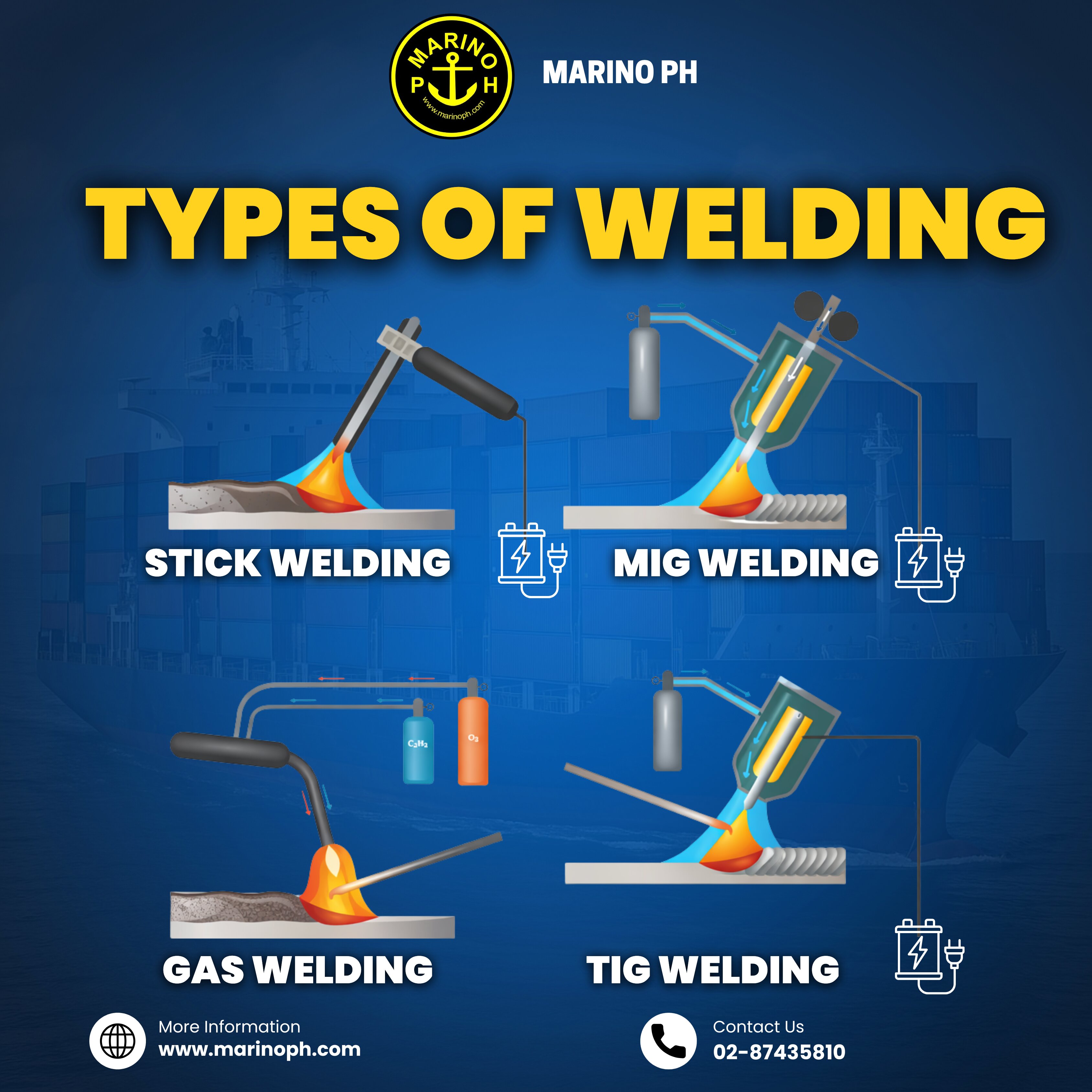
Stick welding
also known as Shielded Metal Arc Welding (SMAW), is one of the most commonly used and versatile welding methods. It utilizes a consumable electrode coated with flux, which creates a protective gas shield when melted to prevent contamination of the weld pool. This method is especially effective for outdoor work and in windy conditions, making it highly suitable for ship repairs, structural steel projects, and heavy equipment maintenance. Its portability and ability to perform well on rusty or dirty surfaces make it a preferred choice for fieldwork and marine repair operations.
MIG welding
Gas Metal Arc Welding (GMAW), uses a continuously fed wire electrode combined with a shielding gas to protect the weld from atmospheric contamination. Known for its speed and efficiency, MIG welding produces clean welds with minimal slag and is relatively easy to learn. It is widely used in fabrication shops, ship component assembly, and industrial production environments where consistency and productivity are important. This method is ideal for controlled indoor settings where high output and smooth finishes are required.

ADVERTISMENT
Gas welding
commonly referred to as oxy-acetylene welding, relies on a flame generated by mixing oxygen and acetylene gases to melt and join metals. As one of the earliest welding techniques developed, it remains valuable for certain applications, particularly where electricity may not be readily available. Gas welding is suitable for thin materials, light fabrication, pipe repairs, and maintenance tasks. Although it is less common in modern heavy manufacturing, it continues to serve practical purposes in specialized and remote operations.
TIG welding
also known as Gas Tungsten Arc Welding (GTAW), uses a non-consumable tungsten electrode along with a shielding gas to produce precise and high-quality welds. A separate filler rod can be added manually when needed. This method offers exceptional control, resulting in clean, strong, and visually refined welds. TIG welding is widely used for stainless steel, aluminum, pressure pipes, and critical marine components where precision and structural integrity are essential. It is often chosen for projects that demand both strength and aesthetic quality.
Summary of the Topic
Each welding method has distinct advantages depending on the material, environment, and project requirements. In marine and industrial applications, selecting the appropriate welding process plays a crucial role in ensuring safety, efficiency, and long term performance. By understanding these welding techniques, companies and professionals can maintain high standards of workmanship and deliver reliable results across a wide range of operations.
