MARINO PH
Your Maritime Digital Hub

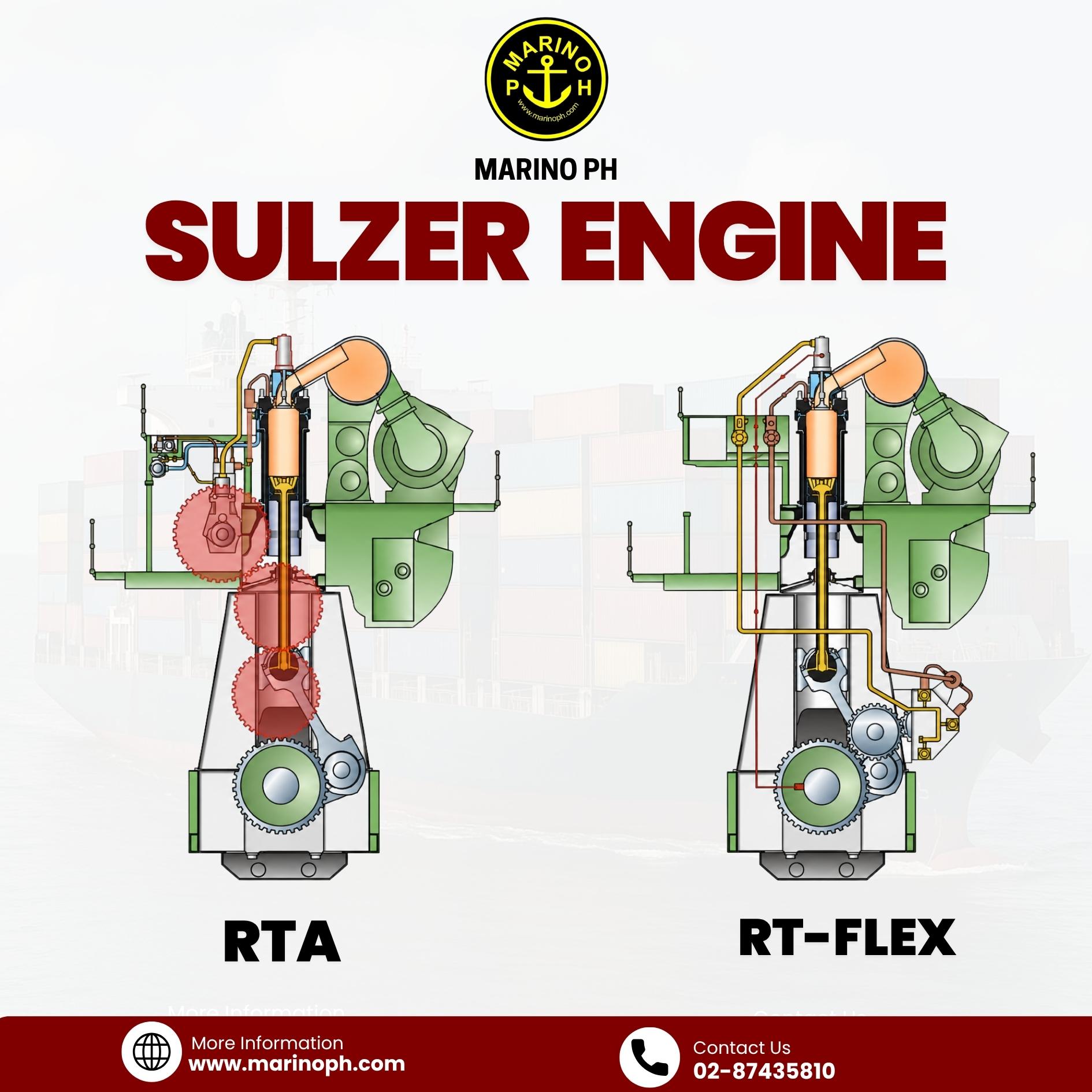
Sulzer marine engines have long played a major role in powering commercial shipping through reliability, fuel efficiency, and continuous technological advancement. Among their most recognized low-speed two-stroke engine designs are the RTA and RT-flex series, each representing different generations of marine engine development and operational capability.
The Sulzer RTA engine is a mechanically controlled low-speed diesel engine designed for dependable performance and straightforward operation. Fuel injection and exhaust valve timing are driven mechanically through camshaft systems, making the engine robust and easier to maintain in traditional shipboard environments. RTA engines became widely used across various vessel types because of their proven durability and efficient fuel consumption during long-distance voyages.

ADVERTISMENT
The Sulzer RT-flex engine introduced electronically controlled technology to improve engine performance and operational flexibility. Instead of relying on mechanical camshafts, RT-flex engines utilize electronic control systems for fuel injection and exhaust timing. This allows more precise combustion control, improved fuel efficiency, smoother operation at lower loads, and reduced exhaust emissions.
One of the key advantages of RT-flex technology is its ability to adapt engine performance according to varying operational demands. Electronic control supports optimized combustion across different speeds, helping vessels achieve better efficiency while meeting increasingly strict environmental requirements.
Both engine platforms remain significant in maritime engineering. While the RTA demonstrates the reliability of traditional mechanical systems, the RT-flex reflects the industry’s transition toward smarter, more efficient, and environmentally responsive propulsion solutions.
