MARINO PH
Your Maritime Digital Hub


Celestial navigation is the practice of determining a vessel\'s position by observing the locations of celestial bodies such as the Sun, Moon, stars, and planets. For centuries, mariners have relied on this traditional method by measuring the altitude of these bodies above the horizon using a sextant. In modern Navigation 4, celestial navigation remains an essential skill, providing a reliable backup method for position fixing and helping seafarers better understand the relationship between the Earth, the sky, and safe navigation. Celestial bodies continue to serve as natural guides, especially when electronic navigation systems are unavailable.
SUN
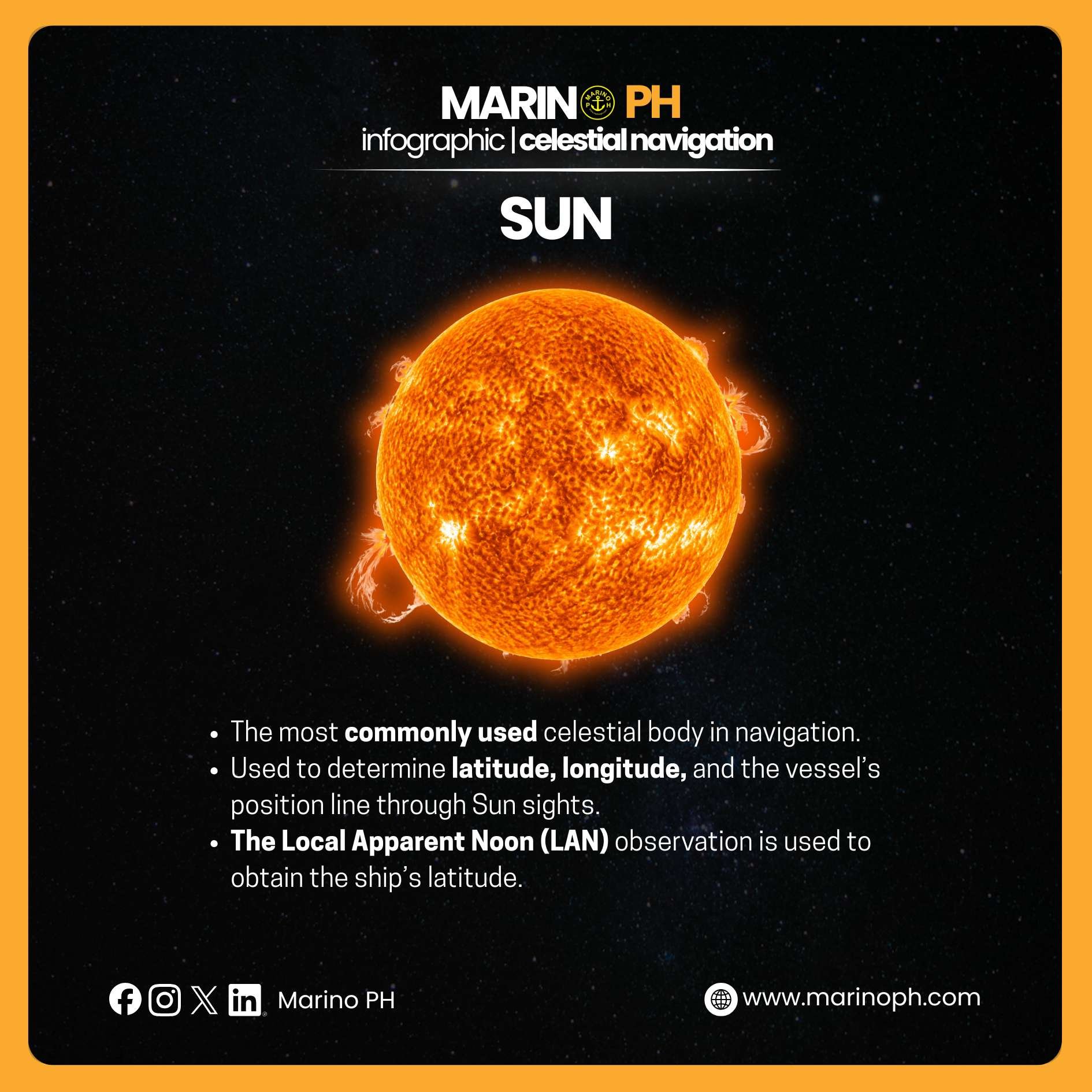
The Sun is the most commonly used celestial body in navigation. It is used to determine latitude, longitude, and a vessel\'s position line through Sun sights. Observing the Sun at Local Apparent Noon (LAN) enables navigators to obtain the ship\'s latitude accurately, making it one of the most reliable celestial bodies for routine position fixing.
MOON
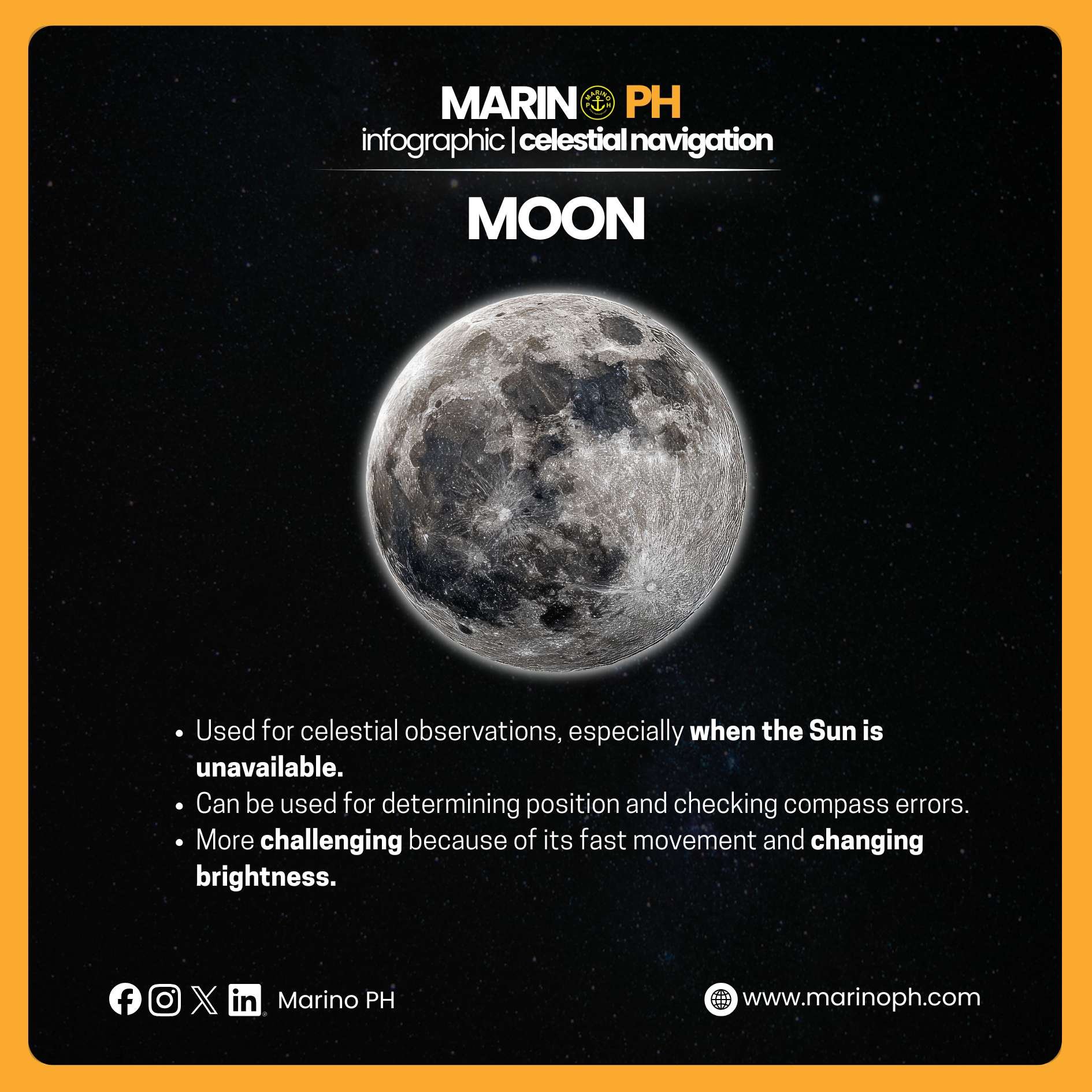
The Moon is used for celestial observations, particularly when the Sun is unavailable. It can be used to determine a vessel\'s position and to check compass errors. However, lunar observations are generally more challenging because of the Moon\'s rapid movement across the sky and its continuously changing brightness and phase.
STARS
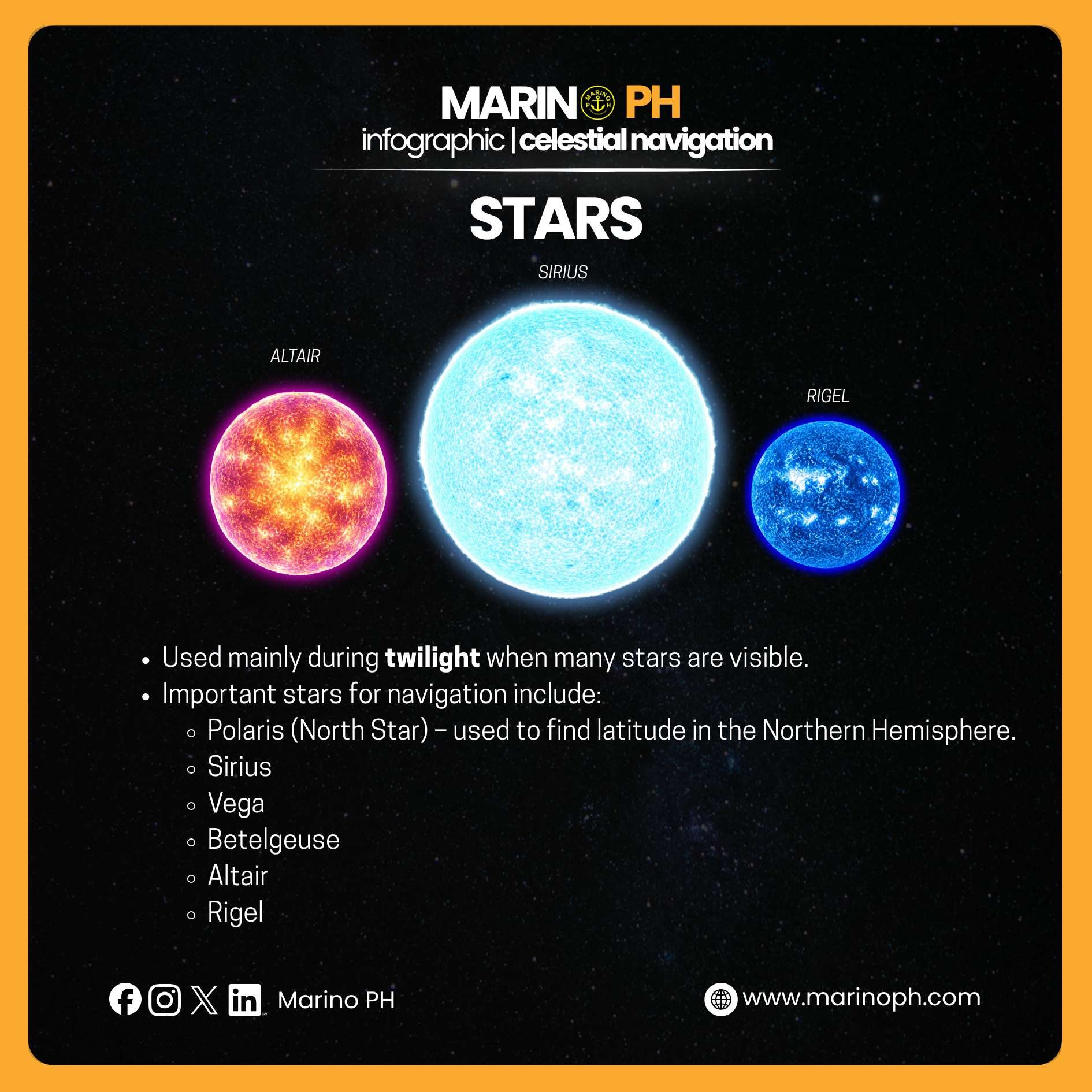
Stars are primarily used during twilight, when both the horizon and several navigational stars are clearly visible. Their fixed positions make them valuable references for celestial navigation. Polaris, also known as the North Star, is especially important because it is used to determine latitude in the Northern Hemisphere. Other commonly used navigational stars include Sirius, Vega, Betelgeuse, Altair, and Rigel.
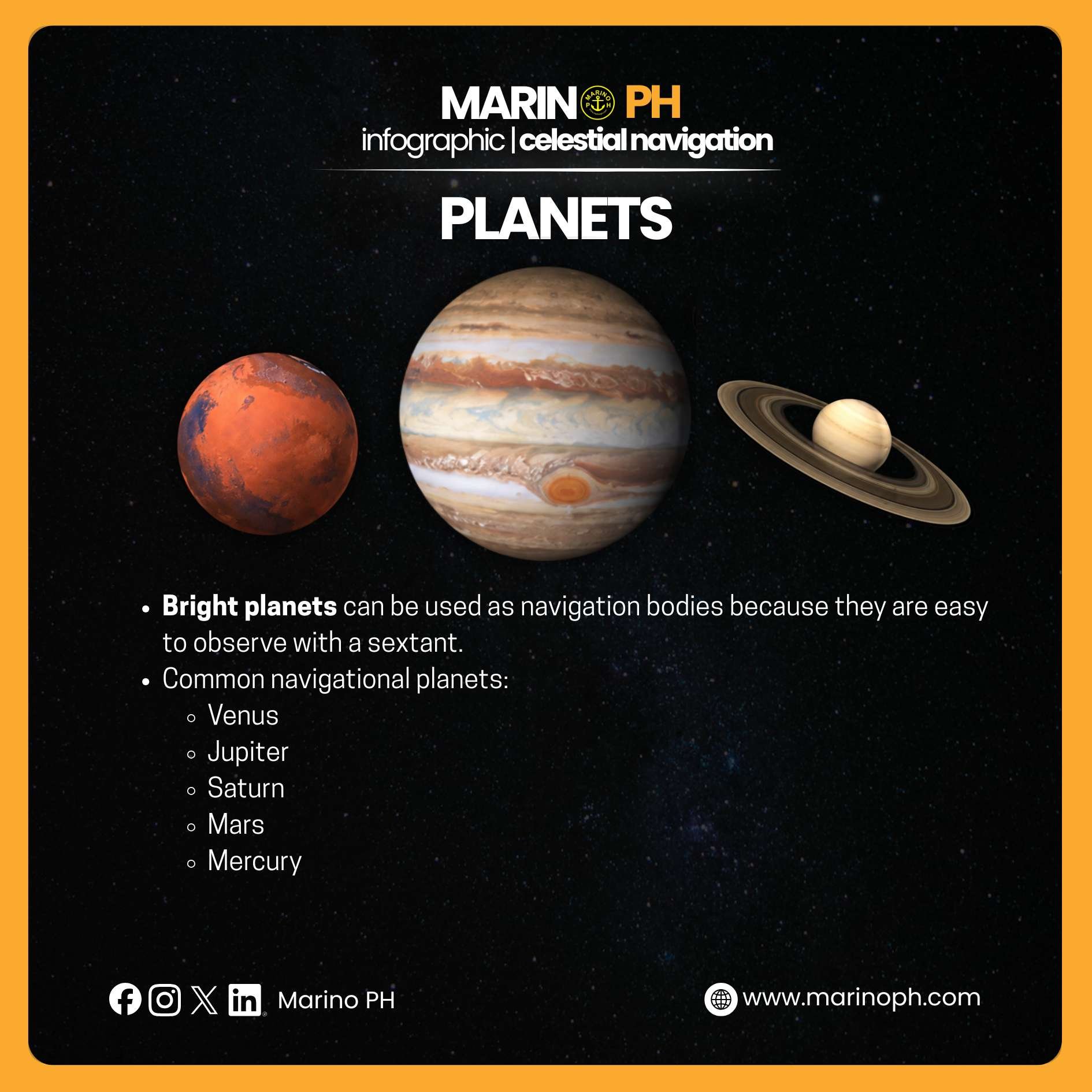
PLANETS
Bright planets are also used as celestial navigation bodies because they are easily identifiable and can be observed with a sextant. Their predictable movements make them useful for determining a vessel\'s position. The most commonly used navigational planets are Venus, Jupiter, Saturn, Mars, and Mercury.

Conclusion
Celestial bodies continue to play an important role in maritime navigation by providing a dependable method of determining a vessel\'s position when electronic navigation systems are unavailable. Understanding how the Sun, Moon, stars, and planets are used in celestial navigation strengthens a seafarer\'s navigational knowledge and reinforces the importance of traditional navigation techniques in ensuring safe and accurate passage at sea.
