
MARINO PH
Your Maritime Digital Hub

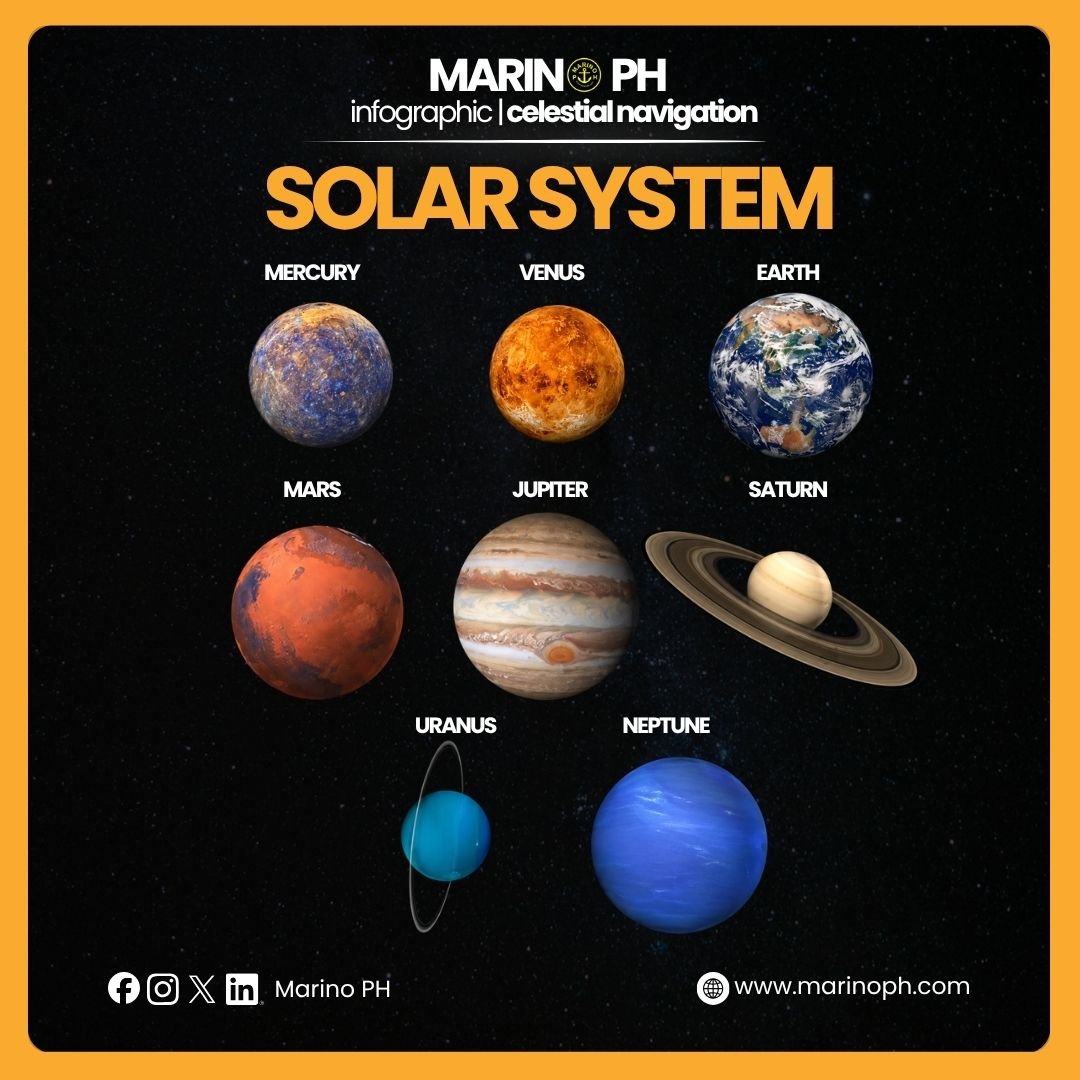
Understanding the solar system remains important in maritime navigation, especially in celestial navigation. Mariners use the Sun, Moon, selected planets, and stars as reference points to determine a vessel’s position when navigating at sea.
Knowledge of celestial bodies also helps navigators understand time, direction, seasonal changes, and astronomical observations used with nautical almanacs and navigation instruments. Even with modern GPS, celestial navigation remains a valuable backup skill for seafarers.

Mercury – The closest planet to the Sun and the smallest planet in the solar system. Because it stays relatively close to the Sun in the sky, it can be difficult to observe for navigation purposes.
Venus – The second planet from the Sun and one of the brightest objects visible in the night sky. Venus is one of the planets commonly used in celestial navigation because it can be easily identified during suitable conditions.
Earth – The third planet from the Sun and the home of all known life. Maritime navigation is based on determining a vessel’s position on Earth using latitude, longitude, celestial observations, charts, and electronic navigation systems.
Mars – The fourth planet from the Sun, commonly recognized by its reddish appearance. Mars can also be used as a celestial navigation body when its position and visibility are suitable.
Jupiter – The fifth planet from the Sun and the largest planet in the solar system. It is very bright and relatively easy to identify, making it useful for certain celestial observations.
Saturn – The sixth planet from the Sun and famous for its large ring system. Saturn can also serve as a celestial reference, although it is generally less bright than Venus or Jupiter.
Uranus – The seventh planet from the Sun. It is very distant and faint, making it difficult to observe with the naked eye and generally impractical for routine celestial navigation.
Neptune – The eighth and farthest major planet from the Sun. It cannot normally be seen without optical equipment and is not generally used for practical celestial navigation.
